

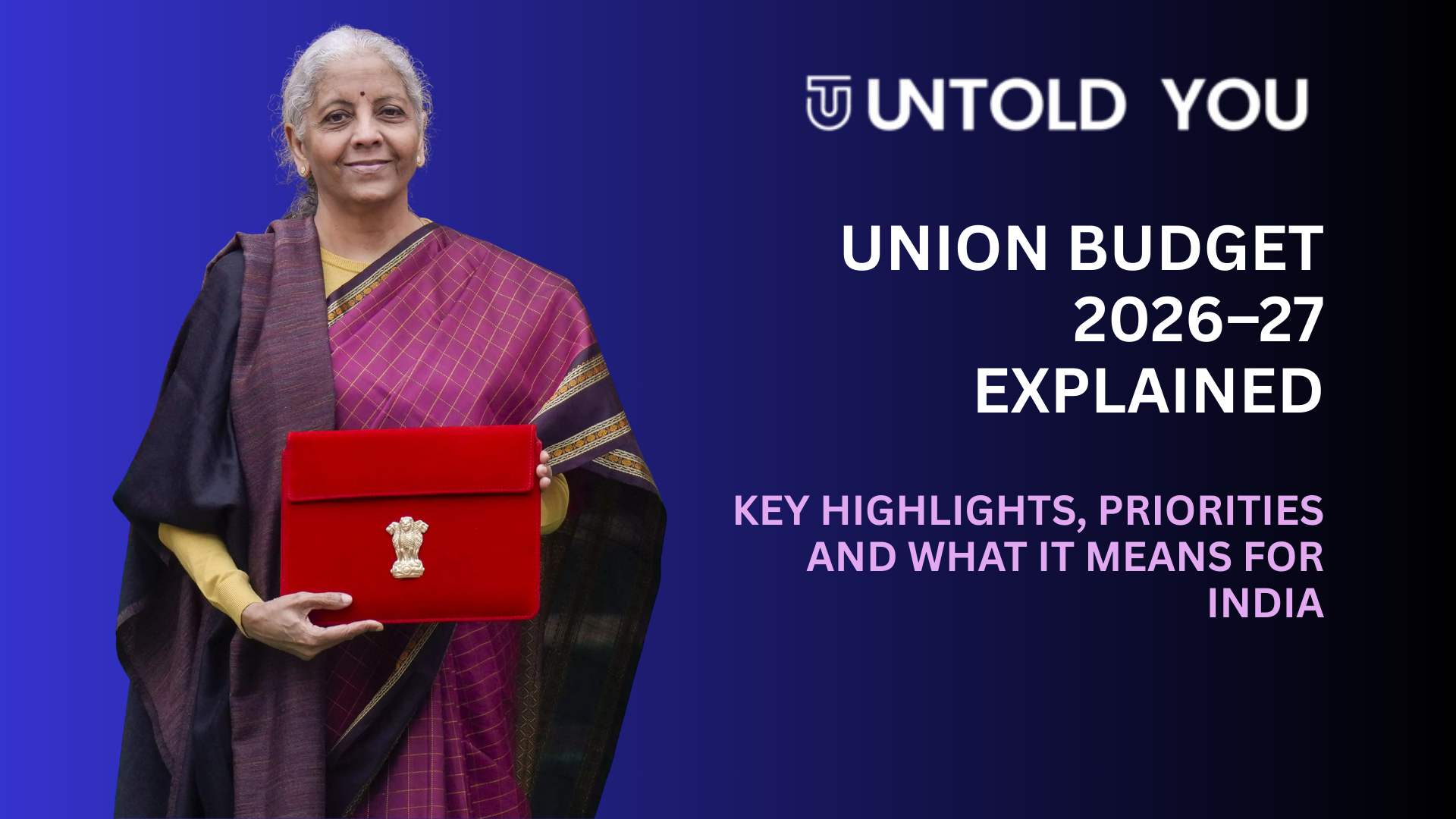
The Union Budget 2026–27, presented by Finance Minister Nirmala Sitharaman, outlines India’s economic priorities for the coming year. The budget focuses on infrastructure-led growth, manufacturing expansion, technology investment, and fiscal discipline, while avoiding populist measures amid global economic uncertainty.
What Is the Total Size of Union Budget 2026–27?
The Union Budget 2026–27 pegs total government expenditure at ₹53.5 lakh crore, with non-debt revenue receipts estimated at ₹36.5 lakh crore.
The government has set:
-
Fiscal deficit: 4.3% of GDP
-
Nominal GDP growth: Around 10%
These projections signal confidence in India’s consumption, investment momentum, and macroeconomic stability.
Why Is Infrastructure the Biggest Focus This Year?
Infrastructure remains the government’s primary growth engine. The budget allocates a record ₹12.2 lakh crore for capital expenditure, an increase of more than 11% year-on-year.
Key infrastructure announcements include:
-
New high-speed rail corridors
-
Expanded road and rail networks
-
Improved freight, logistics, and urban infrastructure
These investments are expected to create jobs, boost productivity, and attract private investment, supporting long-term economic growth.
How Does the Budget Support Manufacturing and Semiconductors?
To strengthen Make in India, the government announced Semiconductor Mission 2.0 with an outlay of ₹40,000 crore.
The mission aims to:
-
Develop India as a global semiconductor manufacturing hub
-
Support chip design and advanced fabrication
-
Reduce dependence on imports
Additionally, MSMEs received targeted support through expanded credit guarantees and easier access to funding, recognising their role in employment generation.
What Does the Budget Offer for Health, Innovation, and Social Sectors?
The budget introduces Biopharma Shakti, a ₹10,000 crore initiative to boost India’s pharmaceutical and biotechnology ecosystem.
Other key social sector measures include:
-
Increased spending on healthcare and education infrastructure
-
Support for women’s hostels
-
Investment in clean mobility, including electric buses
These initiatives reinforce the government’s commitment to inclusive and sustainable development.
Are There Any Changes in Income Tax in Budget 2026–27?
No. The government chose tax stability over surprises.
-
No changes in income tax slabs for individuals
-
Liberalised NRI investment norms to encourage foreign capital inflows
This approach reduces uncertainty for taxpayers and investors alike.
How Much Has Defence Spending Increased?
Defence expenditure crossed ₹7.8 lakh crore in Union Budget 2026–27.
The focus is on:
-
Modernisation of defence forces
-
Indigenous defence manufacturing
-
Strengthening strategic self-reliance
What Is the Overall Message of Union Budget 2026–27?
Prime Minister Narendra Modi described the budget as “human-centric” and future-oriented. The Union Budget 2026–27 prioritises capital creation, innovation, and fiscal prudence, steering clear of short-term populism.
For businesses, startups, and investors, the takeaway is clear:
India’s growth will be driven by infrastructure, technology, manufacturing, and disciplined economic policymaking.
What is the fiscal deficit target in Union Budget 2026–27?
The fiscal deficit target is 4.3% of GDP.
How much capital expenditure is allocated in Budget 2026–27?
The government allocated ₹12.2 lakh crore for capital expenditure.
What is Semiconductor Mission 2.0?
It is a ₹40,000 crore government initiative to promote semiconductor manufacturing and design in India.
Did the budget change income tax slabs?
No, income tax slabs remain unchanged in Union Budget 2026–27.
Which sectors benefit the most from Budget 2026–27?
Infrastructure, manufacturing, semiconductors, MSMEs, healthcare, and defence are the biggest beneficiaries.
